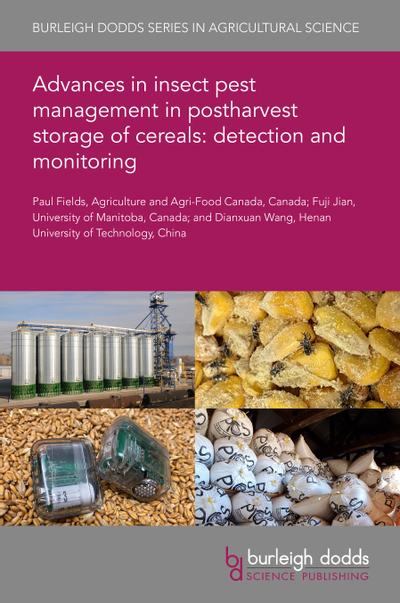
Advances in insect pest management in postharvest storage of cereals: detection and monitoring
Dr Paul Fields, Dr Fuji Jian, Dr Dianxuan WangInformation
-
Publisher
-
ISBN
-
ePub ISBN
- Burleigh Dodds Science Publishing
- 9781786767639
- 9781786767639
-
Published at
-
Pressing
- 2020
- 0
About this book
Sampling grain for stored grain insects is expensive in time and resources. Stored-product insects which damage the grain are small, cryptic and often difficult to find. Many of the sampling methods are unreliable and prone to false negatives. There are two broad types of estimates of population that sampling will provide: absolute or relative. Absolute estimates of population densities for a given unit; grain sample (weight), area of floor (area) or air sample (volume). Insects are extracted from the sample, identified and counted. Relative estimates can use traps to catch insects. There are several factors that effect trap catch including species, grain temperature, trap placement, trap type and last but not least insect population density. In this chapter, the authors outline the methods of detecting insects; imaging, NIR, visible light, microwaves, X-rays, sound, and DNA. Sampling theory is discussed with respect to sample number, sample unit and sample size, economic thresholds, sequential sampling and predictive models.
Note: Some books are only available in specific countries.
Therefore, always check if your books are available in your country before subscribing by using the search function in the app at buku.app.